You have a logo you’re proud of, and you want it turned into a patch that does it justice. Then you start researching and hit a wall of options: embroidered, PVC, woven, chenille, leather, printed. They all look fine in the product photos, so how are you actually supposed to choose?
The honest answer is that there is no single “best” patch type — there is only the right one for your specific logo. A design that looks crisp as a woven label can look clumsy in thread, and a bold, simple emblem that shines as a PVC patch can be a waste of money in fine embroidery. After making millions of patches for clubs, brands, uniforms and events, we’ve learned that 90% of disappointing patches come down to one thing: the wrong type was chosen for the artwork.
This guide breaks down the three most popular options — embroidered, PVC and woven — so you can match your logo to the right method before you order. No jargon, no upselling, just how each one actually behaves.
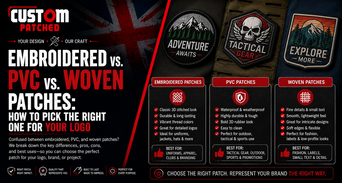
Embroidered patches are made by stitching coloured thread onto a backing fabric. They’re what most people picture when they think “patch” — that raised, tactile, slightly fuzzy surface you find on varsity jackets, scout uniforms and biker vests. The texture is the whole appeal: it reads as premium and traditional in a way a flat print never quite matches.
Where embroidery struggles is fine detail. Each strand of thread has a physical thickness, so there’s a limit to how small a feature can be before it blurs. Thin lettering under about 5 mm tall, gradients, and photo-realistic artwork are all difficult to reproduce. A good factory can use “thread breaks” and stitch-direction tricks to push detail further, but if your logo is genuinely intricate, embroidery will simplify it whether you want it to or not.
Choose embroidered if: your logo has 2–6 solid colours, bold shapes and minimal small text, and you want a traditional, high-perceived-value finish. Explore options on our embroidered patches page, or go for 3D embroidered patches if you want raised, foam-backed lettering.
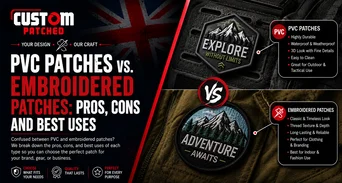
PVC patches are moulded from soft rubber rather than stitched. Colours sit in separate moulded “wells”, which gives clean edges, true 3D layering and a finish that shrugs off rain, mud, sweat and UV. This is why you see them on tactical gear, outdoor brands, marine equipment and sportswear — they survive conditions that would fade or fray an embroidered patch.
The trade-offs are upfront cost and detail handling. Because PVC requires a custom mould, small runs cost more per unit than embroidery. And while PVC handles bold logos and layered depth beautifully, very fine lines and small text need a minimum width to mould cleanly. PVC is a “bold and tough” medium, not a “fine and delicate” one.
Choose PVC if: your patch will live outdoors or take abuse, you want a modern 3D look, or you need exact, repeatable colour matching. See our PVC patches page for sizing and backing options.
Woven patches are made on a loom using fine threads — much thinner than embroidery thread — so they can hold remarkably small detail. If your logo has tiny serif text, thin outlines, or intricate linework that embroidery keeps “swallowing”, weaving is usually the answer. The surface is flat and smooth rather than raised, with a clean, almost printed sharpness.
The compromise is texture and presence. Woven patches lack the chunky, premium relief of embroidery, so they can feel less “special” in the hand even though they reproduce your design more accurately. They’re the practical choice when fidelity matters more than feel. Many clothing brands use them as woven labels precisely because they hold small brand marks cleanly.
Choose woven if: your logo is detailed, contains small text, or has thin lines that thicker embroidery thread can’t reproduce.
| Feature | Embroidered | PVC | Woven |
|---|---|---|---|
| Detail / small text | Limited | Moderate | Excellent |
| Texture / premium feel | Excellent | Good (3D) | Flat |
| Durability outdoors | Good | Excellent | Good |
| Colour accuracy | Good | Excellent | Very good |
| Best for | Classic badges | Tough, outdoor, 3D | Fine, detailed logos |
Forget the patch types for a second and look at your artwork. Three questions settle most decisions:
Once you’ve matched your logo to the right method, the ordering process is refreshingly simple. When you order custom patches in the UK, a good supplier should ask for your artwork in the highest resolution you have, your preferred size in millimetres, your backing choice (iron-on, sew-on, Velcro or adhesive), and your quantity. From there you should receive a digital proof before anything goes into production — never approve a patch you haven’t seen mocked up first.
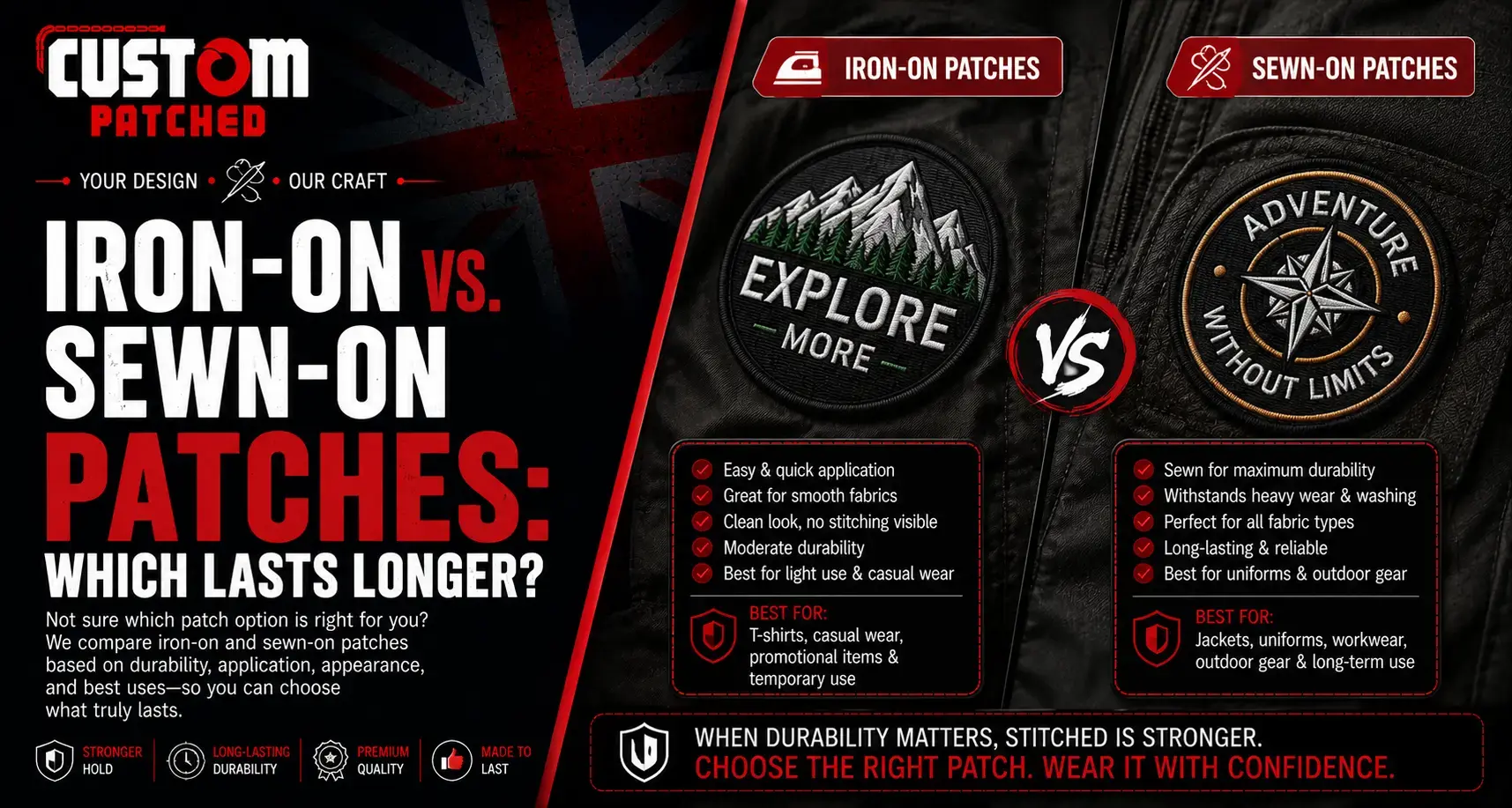
Two details quietly make or break the finished product. The first is backing: iron-on is convenient but not ideal for items that are washed frequently or stretch, where sew-on lasts far longer. The second is border: a merrowed (overlocked) border suits simple shapes, while a hot-cut or laser-cut border lets you follow the exact outline of a complex logo. The right factory will guide you on both rather than leaving you to guess.
The patch type sets the ceiling for quality; the manufacturer decides whether you reach it. The same embroidered design can come back looking sharp and dense from one workshop and loose and gappy from another, because stitch density, thread quality and digitising skill vary enormously. This is why finding the best embroidery patch factory in the UK matters as much as the method you pick — experienced digitisers know how to translate flat artwork into stitch paths that hold detail and lie flat without puckering.
When you’re comparing suppliers, look for a few green flags: they show you a proof before production, they’re transparent about minimum orders and turnaround, they can advise across multiple patch types rather than pushing one, and they back the work with a clear returns or remake policy. A manufacturer that only ever recommends their most expensive option isn’t advising you — they’re selling to you.
Whichever type you choose, a little care protects your investment. Turn garments inside out before washing, use a cool or warm cycle rather than hot, and avoid tumble-drying iron-on patches on high heat, which can soften the adhesive over time. For anything that will be washed weekly — workwear and uniforms especially — ask for sew-on backing or have iron-on patches stitched down around the edge for a bond that won’t lift.
For small to medium runs, embroidered and woven are usually the most economical, since PVC carries a one-off mould cost. At higher volumes that mould cost spreads out and PVC becomes very competitive.
Woven is almost always the right call for fine text. If you’re set on embroidery, consider enlarging the patch or simplifying the smallest elements so the thread can hold them.
Yes. Many customers run an embroidered version for apparel and a PVC version for outdoor gear from the same logo. Just ask for both at quote stage.
Free Quote · Digital Proof · No Obligation
Send us your artwork and our team will recommend the right patch type, size and backing — with a free quote and a digital proof before anything is made.
Get My Free Quote Browse the Patch RangeSend us your logo and we’ll recommend the perfect patch — with a free, no-obligation quote.
Request Quote

🛒 New Order Received!