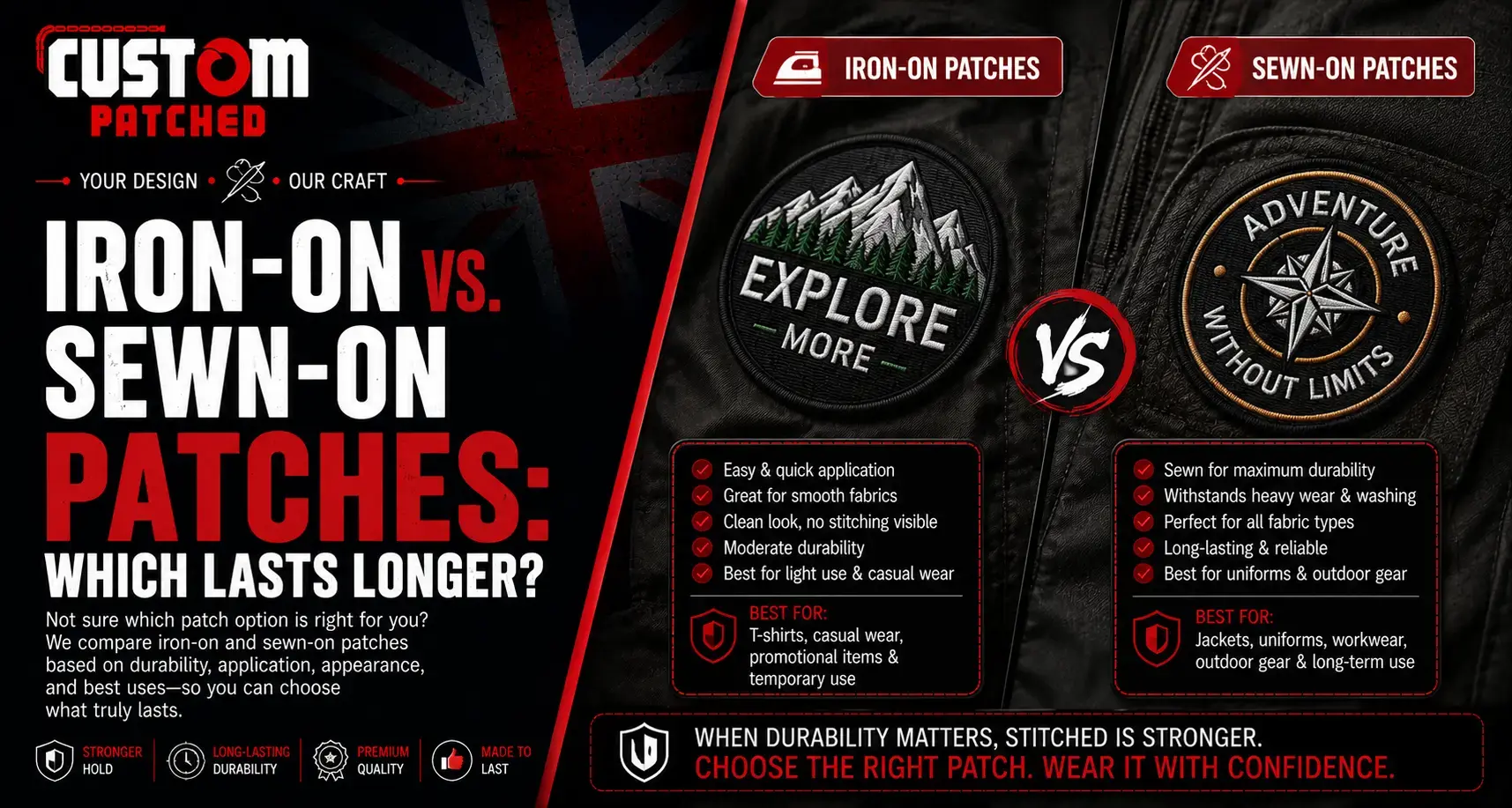

You have probably had this happen. A patch goes on a jacket looking sharp, then three washes later the corners start curling and the whole thing peels off mid cycle. That single bad experience is usually a backing problem, not a quality problem, and it is the question we get asked more than almost any other: should you go with iron-on or sewn-on?
This guide settles it with real numbers, a clear comparison table, and a quick decision chart, so you can order the right backing the first time instead of finding out the hard way.
Most buyers assume a patch is a patch, and the backing is just a finishing detail. In practice, the backing decides whether your design survives six months of daily wear or six washes before it starts lifting at the edges. Get it wrong and you end up reordering, which costs more in the long run than getting advice up front.
Iron-on patches use a heat activated adhesive on the back. Press it with a household iron or heat press and the glue melts into the fabric fibres, creating a bond that is strong on day one.
The catch is that heat activated adhesive weakens gradually. Industry data and our own production experience put the realistic lifespan at around 20 to 30 washes before the edges begin to lift, especially on synthetic fabrics that do not grip adhesive as well as cotton does. Tumble drying on high heat speeds this up considerably.
Iron-on is the right call when you need something fast, low cost, and applied without a needle, for example event giveaways, temporary promotional wear, or test runs before a bulk order.
Sewn-on patches are stitched directly into the fabric around the patch border. There is no adhesive to break down, no heat exposure to weaken over time, and the bond moves with the fabric instead of resisting it.
This is why sewn patches are the standard for anything that gets washed often or worn hard. A well stitched patch routinely outlasts the garment itself, often holding for ten years or more, which is also why uniforms, workwear, and motorcycle gear are almost always sewn rather than ironed.
| Factor | Iron-On | Sewn-On |
|---|---|---|
| Average lifespan | 20 to 30 washes | 10+ years |
| Application method | Household iron or heat press | Sewing machine or hand stitching |
| Best for | Temporary wear, giveaways, soft goods | Uniforms, jackets, workwear, bags |
| Resistance to heat and tumble drying | Weak | Strong |
| Setup effort | Minimal, no sewing needed | Requires stitching time |
| Typical cost impact | Lower | Slightly higher labour cost |
The chart below scores each backing type out of 10 based on how well it holds up under regular washing and daily wear.
Durability Score by Backing Type (out of 10)5Iron-On, 6Velcro, 9Sewn-On scores reflect typical performance across regular machine washing and everyday wear
Sewn-on patches consistently outscore the alternatives once washing enters the picture, which is exactly why they dominate anywhere durability actually matters.
Iron-on is not a lesser option, it is the right tool for specific jobs. Reach for iron-on when you are running a one-off event, testing a design before committing to a bulk order, applying patches to soft items that cannot be machine sewn, or fitting out something that will only be worn occasionally rather than daily.
Choose sewn-on whenever the garment will be washed regularly, worn for physical work, or needs to last years rather than months. This covers school uniforms, biker and outdoor jackets, hospitality and trade workwear, and club or team kit that gets used week after week. If you are kitting out staff uniforms specifically, our guide to custom name tag patches for uniforms goes deeper into backing choices for that exact use case.
Yes. Many of our patches are made with iron-on backing plus pre-punched holes around the border. So you get the quick initial hold of adhesive with the option. To reinforce with a few stitches for permanent wear. It is the practical middle ground when you want a fast application now with the security of stitching later.
If the item will be washed more than once a month, choose sewn-on. It is a one-time event, a gift, or a trial design, iron-on will do the job. If you are not sure yet, order a small batch with the hybrid backing and test it on the actual garment before committing to a larger run. This also ties into how minimum order quantities work for custom patches.
Not immediately, but the adhesive does weaken with repeated washing and high heat drying. Expect solid performance for around 20 to 30 washes before the edges start to lift, depending on the fabric and how the patch was applied.
Yes. Adding a few stitches around the border of an iron-on patch, particularly at the corners where lifting starts first, significantly extends its life and is a common fix for patches on items that get washed often.
A properly stitched patch typically lasts as long as the garment itself, often ten years or more, because the thread bond does not break down with heat or detergent the way adhesive does.
Slightly, because stitching takes more production time than applying adhesive. The difference is usually small compared to the cost of reordering patches that failed early, which is the real expense iron-on can carry on high-wash items.
Sewn-on, every time. Leather and heavy outerwear get exposed to friction, weather, and infrequent washing combined with long-term wear. Which is exactly where stitched patches outperform adhesive by a wide margin.
Tell us what the patch is going for, a uniform, a jacket, an event. Or a one-off gift, and we will recommend the right backing before you order. Get a free quote or browse our embroidered patches range to see backing options in action.


🛒 New Order Received!